The Lich King's Helm of Domination
An encyclopedic analysis of the Helm of Domination, the artifact that defines the Lich King and governs undead control in Warcraft.
ARTIFACTS
Type
Necromantic control artifact; soul-binding crown
Origin
Forged by the Burning Legion as the command component of the Lich King system.
Primary bearers
Ner'zhul (bound spirit)
Arthas Menethil (dominant incarnation)
Bolvar Fordragon (successor and containment bearer)
Status
Destroyed during later canonical events.
Associated artifacts
Frozen Throne
The Helm of Domination is the defining artifact of the Lich King. It does not amplify an existing ruler. It creates the role itself.
Origin and Design Intent
The Helm of Domination was created by the Burning Legion to imprison and weaponize the spirit of Ner’zhul. Its purpose was not symbolic kingship but centralized control over undeath. Where Frostmourne harvests and binds souls, the Helm governs them.
Canon sources establish that the Helm was never intended to be worn casually. It was designed to overwrite the bearer’s identity through sustained exposure, fusing consciousness with necromantic command structures embedded within the artifact.
The Frozen Throne functioned as a containment and stabilization apparatus for the Helm, limiting its output while enabling long-term control.
Physical Description
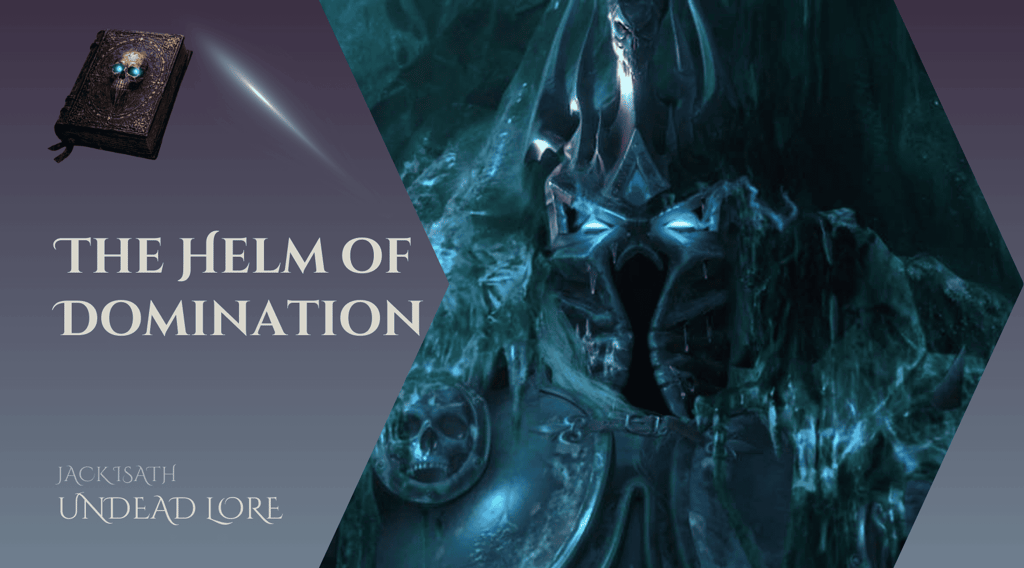
The Helm of Domination is depicted as a heavy, spiked crown forged from dark, rune-etched metal. Its design emphasizes enclosure and pressure rather than ornament. Prominent runes associated with domination and death magic are inscribed along its surface.
When worn, the Helm emits restrained arcane illumination, typically rendered as cold blue or violet light concentrated around the eye sockets. The artifact is visually static, reinforcing its role as a locus of control rather than an active weapon.

Functional Properties
Centralized Command
The Helm of Domination establishes a psychic network linking all undead under the Scourge. This network allows the bearer to issue commands instantaneously, suppress individual will, and coordinate vast undead forces as a unified system.
Undead bound to this network do not require loyalty, belief, or fear. Obedience is enforced structurally rather than emotionally.
Identity Overwrite
Extended contact with the Helm alters the bearer’s consciousness. Canon depicts this process as gradual but irreversible. The wearer’s personality is preserved initially, but increasingly subsumed by the Helm’s embedded imperatives.
In the case of Arthas Menethil, the Helm facilitated the merger of his consciousness with Ner’zhul’s. Over time, Arthas’s will dominated, but the resulting entity remained bound to the Helm’s operational logic.
Role Enforcement
The Helm does not merely grant power. It imposes responsibility. Canon establishes that the Scourge cannot exist without a controlling intelligence. When the Helm is left unclaimed, undead activity becomes chaotic and catastrophic.
This requirement is explicitly articulated through the assertion that “there must always be a Lich King.”
Relationship to Frostmourne
The Helm of Domination and Frostmourne are complementary components of a single system.
Frostmourne acquires souls, creates death knights, and enforces individual domination.
The Helm of Domination coordinates, governs, and sustains the undead collective.
Neither artifact is fully functional alone. Frostmourne without the Helm produces powerful but directionless undead. The Helm without Frostmourne lacks the means to replenish or expand control.
The bearer of both artifacts becomes the operational center of the system.
Role in Arthas Menethil’s Ascension
Arthas Menethil’s assumption of the Helm marks the completion of his transformation. By donning the Helm at Icecrown, Arthas becomes the Lich King.
Canon sources indicate that the merger between Arthas and Ner’zhul occurs within the Helm’s psychic space. While initial depictions suggest a dual consciousness, later material confirms Arthas’s dominance, with Ner’zhul’s identity effectively erased.
From this point onward, Arthas is no longer influenced by external voices. The Helm ceases to persuade and instead executes.
Containment and Succession
Following Arthas’s defeat, the Helm of Domination remains intact and active. Its continued existence necessitates immediate succession to prevent uncontrolled undead activity.
Bolvar Fordragon assumes the Helm, reframing the role of the Lich King from conqueror to jailer. In this configuration, the Helm is used to contain the Scourge rather than expand it.
This period demonstrates that the Helm defines function, not intent. Its power adapts to the will of the bearer, but its structural demands remain unchanged.
Destruction and Consequences
The destruction of the Helm of Domination represents the collapse of the Lich King system. With its removal, the centralized control binding the undead is severed permanently.
Canon sources depict this act as destabilizing long-established metaphysical structures governing death and undeath. The long-term consequences include the loss of enforced containment and the reconfiguration of undead power away from singular authority.
Narrative Function
The Helm of Domination serves as a narrative exploration of governance through absolute control. Unlike crowns that symbolize rule, the Helm enforces it mechanically.
Its existence reframes kingship as infrastructure. Authority is not granted by lineage, consent, or legitimacy, but by capacity to impose order on death itself.
Legacy
The Helm of Domination is one of the most influential artifacts in fantasy media. It establishes a model of power defined by obligation rather than ambition, and immortality framed as perpetual responsibility.
Within Warcraft, the Helm does not represent corruption alone. It represents the cost of maintaining order when death itself refuses to remain contained.
The Lich King is not born. He is worn.