The Lich King: Arthas Menethil
An encyclopedic biography of Arthas Menethil, the Lich King of Warcraft, detailing his fall from paladin to death knight and master of the Scourge.
CHARACTERS
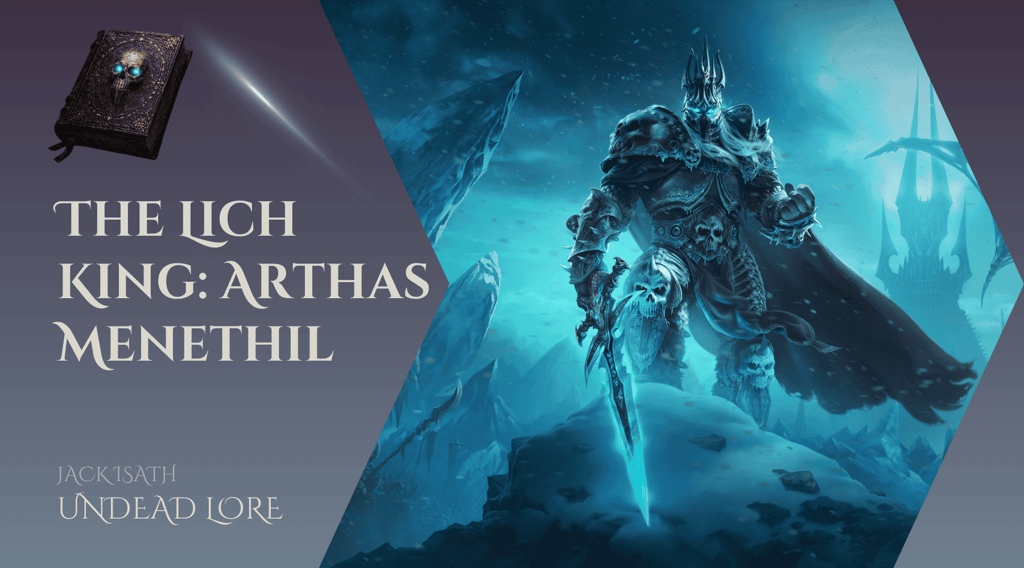
Arthas Menethil, Crown Prince of Lordaeron; Knight of the Silver Hand; Death Knight of the Scourge; The Lich King.
Origin and setting
Arthas Menethil originates from the high medieval fantasy world of Azeroth, within the Warcraft franchise. His story unfolds primarily across Warcraft III: Reign of Chaos, Warcraft III: The Frozen Throne, and World of Warcraft, culminating during the Wrath of the Lich King expansion.
Affiliations
Kingdom of Lordaeron
Silver Hand
The Scourge (as Death Knight and later Lich King)
Ontological status
Undead. Arthas exists as a merged necromantic entity, having lost his mortal soul and later assumed the mantle of the Lich King.
Defining canonical events
Key events include:
The Story as It Unfolds
Arthas Menethil was born the sole heir to the throne of Lordaeron and raised under the expectations of kingship, military leadership, and moral responsibility. He was trained as a paladin of the Silver Hand, combining martial discipline with the Light-based doctrines that defined Lordaeron’s religious and political authority. Early depictions present Arthas as earnest, confident, and deeply committed to protecting his people, though increasingly intolerant of perceived failure or hesitation.
The inciting crisis of Arthas’s life occurs during the outbreak of the undead plague in northern Lordaeron. Investigations into the spread of the plague reveal grain shipments tainted with necromantic corruption, transforming civilians into undead. Arthas’s pursuit of the source leads him to the city of Stratholme, where he determines that the population has already been infected. Against the objections of his mentor Uther the Lightbringer and the mage Jaina Proudmoore, Arthas orders the systematic killing of the city’s inhabitants to prevent their transformation. This event, known as the Culling of Stratholme, marks the first irreversible rupture between Arthas and the moral framework of the Light.
Following Stratholme, Arthas becomes increasingly singular in purpose. He pursues the dreadlord Mal'Ganis to the frozen continent of Northrend, believing the destruction of this enemy to be the only path to ending the plague. Isolated from allies and driven by mounting desperation, Arthas authorizes increasingly extreme measures, including the betrayal and abandonment of mercenaries and the burning of his own fleet to prevent retreat.
In Northrend, Arthas encounters the runeblade Frostmourne, a weapon promising the power to defeat Mal’Ganis. Despite explicit warnings that the blade would consume his soul, Arthas claims it, sacrificing his remaining moral agency in exchange for victory. Frostmourne severs Arthas’s soul upon contact, binding it to the blade and placing him under the influence of the Lich King.
Returning to Lordaeron as a death knight, Arthas assassinates his father, King Terenas Menethil II, and initiates the kingdom’s collapse from within. He dismantles Lordaeron’s institutions, raises fallen knights into undeath, and prepares Azeroth for the Scourge’s expansion. His actions during this period establish the Scourge as a coherent necromantic empire rather than a chaotic plague.
Arthas later travels once more to Northrend, where the spirit of the orc shaman Ner'zhul remains bound within the Frozen Throne. Upon reaching Icecrown, Arthas dons the Helm of Domination, merging his consciousness with Ner’zhul and assuming full control of the Lich King’s power. Canon sources depict Arthas’s personality ultimately subsuming Ner’zhul’s, resulting in a unified entity dominated by Arthas’s will.

Philosophy and Motivation
Arthas’s actions are consistently motivated by a belief that protection of the realm justifies unlimited authority and violence. Early in his career, this belief is framed as duty and sacrifice. As his story progresses, the same logic is preserved but stripped of restraint, transforming protection into domination.
Canonical depictions emphasize Arthas’s intolerance for uncertainty and delay. Compromise, mercy, and institutional process are repeatedly portrayed as weaknesses in moments of crisis. His embrace of Frostmourne and later of the Lich King’s power represents a shift from shared responsibility to absolute control. Undeath becomes, in Arthas’s framework, the only system capable of imposing permanent order on a world he perceives as fragile and corruptible.
The Nature of His Undeath
Arthas does not become a lich in the classical sense. His undeath is structured through external artifacts rather than a self-created phylactery. His soul is initially bound to Frostmourne and later integrated into the Helm of Domination, which serves as both nexus node and control interface.
As the Lich King, Arthas functions as a centralized necromantic authority. The undead of the Scourge are psychically linked to him, drawing coherence and purpose from his will. This configuration renders the Scourge dependent on the continued existence of a Lich King, a fact later confirmed by his father's ghost King Terenas Menethil II who said “there must always be a Lich King” to contain the undead threat.
Arthas’s undeath preserves memory, identity, and strategic reasoning while eliminating empathy and moral hesitation. Canon sources depict his human sentiments, including affection and regret, as consciously suppressed rather than erased, reinforcing the interpretation of undeath as enforced stasis rather than transformation.
Reign as the Lich King
From Icecrown Citadel, Arthas rules the Scourge as a singular autocrat. His governance model prioritizes expansion, containment, and preparedness over conquest for its own sake. The Scourge is used to weaken Azeroth’s civilizations, harvest resources, and test potential champions.
During the events of World of Warcraft: Wrath of the Lich King, Arthas deliberately engineers repeated defeats and resurrections of Azeroth’s champions, seeking to forge the strongest possible undead servants. This strategy culminates in his confrontation with the world’s greatest heroes within Icecrown Citadel.
Defeat and Aftermath
Arthas is defeated atop Icecrown Citadel by a coalition of Azeroth’s champions. At the moment of his death, brief canonical dialogue suggests a fleeting return of self-awareness and redemption. Following his fall, the destabilization of the Scourge necessitates the immediate succession of a new Lich King.
Bolvar Fordragon assumes the Helm of Domination, becoming the next Lich King to prevent uncontrolled devastation. Arthas’s spirit dissipates, and his story concludes without resurrection or continuation.

What This Character Communicates
Arthas Menethil persists as a central figure in fantasy media due to the clarity of his arc. His transformation follows a continuous internal logic in which each compromise enables the next escalation. Rather than portraying corruption as sudden or accidental, the narrative frames Arthas’s fall as the cumulative result of choices made under pressure.
Within the Warcraft setting, Arthas embodies the failure of absolutist solutions to existential threats. His reign demonstrates that systems built on total control require constant enforcement and ultimately collapse under their own rigidity.
Legacy Across Media
Arthas Menethil remains one of the most recognizable antagonists in video game history. His story has been retold through campaigns, novels, cinematics, and expansions, and continues to serve as a reference point for discussions of tragedy, power, and undeath in fantasy storytelling.
His depiction established the modern template for the death knight archetype and influenced subsequent portrayals of undead rulers across games and related media.