
The Lich King's Sword: Frostmourne
An encyclopedic guide to Frostmourne, the sentient runeblade of Warcraft, detailing its origin, soul-harvesting power, and role in Arthas’s fall.
ARTIFACTS
Type
Sentient runeblade; necromantic artifact
Origin
Forged by the Burning Legion as part of the Lich King containment and deployment system.
Primary bearers
Arthas Menethil (primary and final wielder)
Wielded indirectly through the will of Ner'zhul prior to Arthas’s ascension
Status
Destroyed during the events of World of Warcraft: Wrath of the Lich King
Associated artifacts
Helm of Domination
Frozen Throne
Frostmourne is one of the most significant necromantic artifacts in the Warcraft franchise, functioning as both a weapon and a soul-binding mechanism integral to the operation of the Lich King.
Origin and Purpose
Frostmourne was created by the Burning Legion as a controlled instrument of domination. Its design objective was to enable the imprisoned spirit of Ner’zhul to exert influence over the physical world by corrupting and empowering a mortal champion.
The blade was intentionally placed in Northrend, embedded within magical ice, and surrounded by warnings meant to be discovered rather than avoided. Canon sources indicate this placement was a deliberate lure, intended to attract a wielder capable of bearing its power and executing the Lich King’s will.
Frostmourne was never meant to function independently. It was engineered as one half of a paired necromantic system, with the Helm of Domination serving as the command and control counterpart.
Physical Description
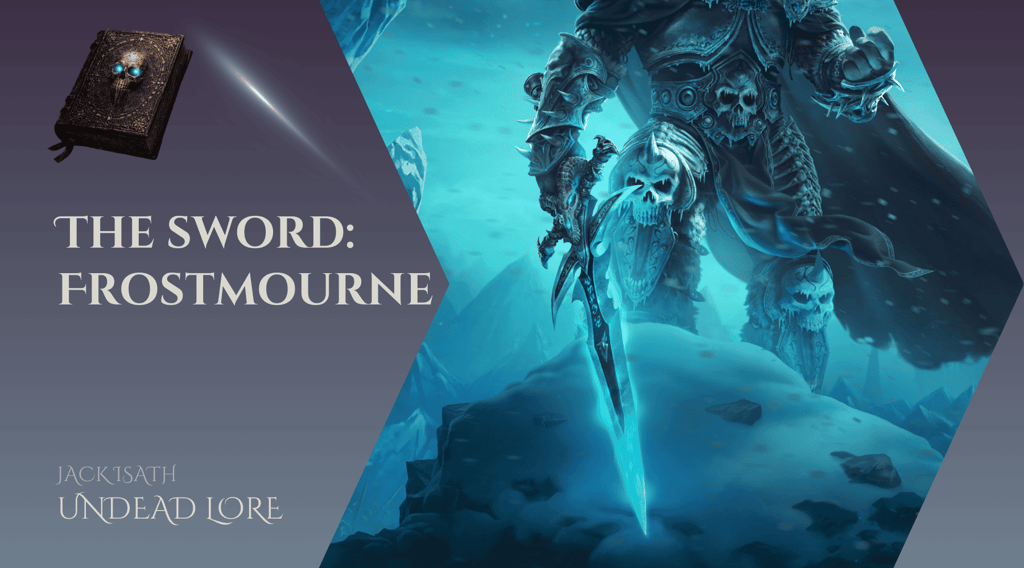
Frostmourne is depicted as a massive, single-edged runeblade with a broad profile and elongated hilt. The blade is etched with glowing runic inscriptions associated with domination and death magic. Its coloration is typically rendered in muted steel tones with cold blue highlights, reinforcing its association with frost, stasis, and containment rather than decay.
The weapon emits an ambient cold and arcane presence, and is often portrayed as radiating restrained necromantic energy rather than overt spectacle.
Functional Properties
Soul Harvesting
Frostmourne’s defining capability is its ability to consume the souls of those it kills. These souls are not destroyed but bound within the blade, where they are used as a power source for necromantic effects. The accumulation of souls directly increases the blade’s potency.
Canon material establishes that particularly significant souls retain awareness while imprisoned, though they are unable to act independently.
Soul Severance
Upon being claimed by Arthas Menethil, Frostmourne immediately severed his soul from his body. This act is described in canon as instantaneous and irreversible. Arthas continued to operate with full cognitive and strategic capacity, but without the moral and emotional constraints associated with a living soul.
This severance marks Frostmourne as an artifact capable not only of harvesting souls, but of transforming its wielder into a soul-dependent undead agent.
Sentience and Influence
Frostmourne is explicitly sentient. Early depictions show the blade communicating with its wielder through whispers, urging decisive action and reframing brutality as necessity. This influence is most prominent prior to Arthas’s full ascension as the Lich King.
Following Arthas’s merger with the Helm of Domination, Frostmourne’s role shifts from persuasive agent to extension of centralized will. At this stage, the blade no longer guides its wielder, but executes intent.

Relationship to the Lich King System
Frostmourne functions as the primary acquisition mechanism within the Lich King’s necromantic infrastructure.
It harvests souls for power and control.
It creates and binds death knights.
It enforces obedience through soul dependency.
The Helm of Domination complements these functions by providing psychic command and coordination over the undead. Together, the two artifacts form a closed system in which Frostmourne supplies resources and agents, while the Helm governs strategy and cohesion.
Arthas Menethil serves as the integrative node between these artifacts, enabling direct translation of will into action.
Role in the Fall of Arthas Menethil
Frostmourne represents the decisive turning point in Arthas Menethil’s transformation into the Lich King.
Canon sources consistently emphasize that Arthas was warned of the blade’s cost prior to claiming it. His decision to take Frostmourne is therefore framed as a conscious acceptance of damnation in exchange for certainty and power. The blade does not deceive him regarding its nature; it rewards his willingness to abandon moral restraint.
From this moment onward, Arthas’s actions are no longer constrained by personal consequence. Frostmourne enables his transition from compromised protector to systemic instrument of undeath.
Use in Warfare
In combat, Frostmourne functions as both a physical weapon and a metaphysical enforcement tool.
Enemies slain by the blade may have their souls bound permanently.
Fallen champions can be raised as death knights or undead servants.
Institutional leaders killed by Frostmourne are removed not only politically, but spiritually.
This dual function allows Frostmourne to dismantle social and military structures while simultaneously strengthening the Scourge.
Destruction and Aftermath
Frostmourne is shattered during the confrontation with the Lich King at Icecrown Citadel. Its destruction releases the souls bound within it, including that of King Terenas Menethil II.
The release of these souls represents the only known reversal of Frostmourne’s effects. However, canon material makes clear that this act does not undo the consequences of the blade’s use, nor does it restore Arthas Menethil.
Narrative Function
Within Warcraft’s narrative framework, Frostmourne serves as a study in consent-based corruption. Unlike artifacts that punish ignorance or hubris, Frostmourne rewards clarity of intent and willingness to sacrifice ethical boundaries.
Its presence reframes power not as growth, but as accumulation through irreversible loss. Success is achieved not by restraint, but by surrendering identity and consequence.
Legacy
Frostmourne remains one of the most influential artifacts in fantasy gaming. Its integration into character transformation, world-scale systems, and narrative causality has shaped subsequent portrayals of soul-binding weapons and death knight archetypes across media.
Even in its destruction, Frostmourne continues to define the structure and consequences of undeath within the Warcraft universe.