
The Lich King: Bolvar Fordragon
An encyclopedic biography of Bolvar Fordragon as the Lich King, covering his reign of containment, sacrifice, and eventual downfall.
CHARACTERS
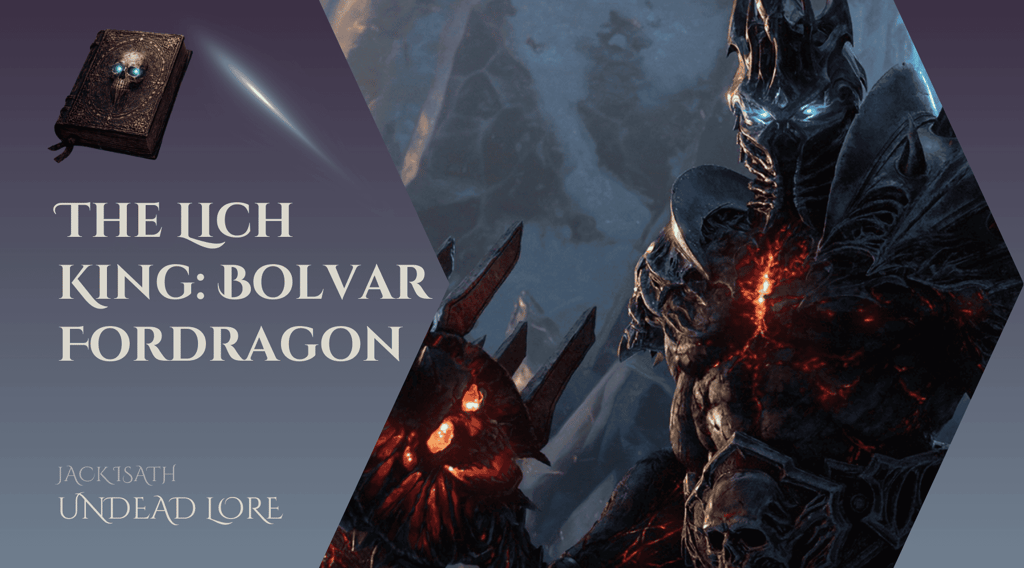
Full name and titles
Bolvar Fordragon, Regent Lord of Stormwind; Highlord of the Alliance; The Lich King.
Origin and setting
Bolvar Fordragon is a human warrior and statesman from Azeroth, whose story unfolds across World of Warcraft, most prominently during Wrath of the Lich King and Shadowlands.
Affiliations
Alliance of Lordaeron
Kingdom of Stormwind
The Lich King (post–Icecrown)
Ontological status
Undead. Bolvar exists in a state of sustained undeath bound to the Helm of Domination, neither fully living nor conventionally dead.
Defining canonical events
Bolvar’s immolation by dragonfire at the Wrathgate, survival through necromantic preservation, voluntary assumption of the Helm of Domination, containment of the Scourge, confrontation with Sylvanas Windrunner, and subsequent defeat and loss of the Helm.
The Story as It Unfolds
Bolvar Fordragon is introduced as a senior military commander and political leader of the Alliance, serving as Regent Lord of Stormwind during King Varian Wrynn’s absence. Canon sources depict Bolvar as disciplined, duty-bound, and oriented toward stability rather than personal ambition. His role prior to undeath is defined by stewardship and containment of crisis rather than conquest.
During the Northrend campaign against the Lich King, Bolvar leads Alliance forces at the Wrathgate. There, he is caught in the deployment of the Forsaken blight orchestrated by Grand Apothecary Putress, which devastates both the Scourge and Alliance forces. Bolvar is struck by the blight and subsequently engulfed in dragonfire by Alexstrasza, an act intended to end his suffering.
Bolvar does not die. Instead, the combined effects of blight, dragonfire, and necromantic influence leave him in a suspended state. Canon establishes that the flames preserve his body while preventing full death, rendering him conscious but immobile. During this period, Bolvar is taken to Icecrown Citadel, where he remains imprisoned and exposed to the influence of the Lich King.
Following the defeat of the first Lich King, Arthas Menethil, at Icecrown Citadel, the Helm of Domination remains intact. The destabilization of the Scourge prompts the immediate need for succession. In the aftermath, Bolvar regains agency and addresses Tirion Fordring, declaring the necessity of a new Lich King to contain the undead.
Bolvar voluntarily dons the Helm of Domination, assuming the mantle of the Lich King. He orders Tirion to tell the world that Bolvar Fordragon died at the Wrathgate, severing all ties to his former identity. From this point forward, Bolvar rules from the Frozen Throne, isolated and unseen.

Philosophy and Motivation
Bolvar’s tenure as Lich King is defined by restraint of the undead rather than an expansion of it. Canon sources consistently frame his motivation as containment. Unlike Arthas Menethil, Bolvar does not seek to conquer Azeroth or reshape it through undeath. His actions are oriented toward preventing the Scourge from overrunning the world.
Bolvar’s prior identity as a regent and caretaker persists in altered form. Authority is exercised reluctantly and defensively. The Helm of Domination imposes control, but Bolvar’s will channels that control toward stasis rather than escalation.
His secrecy is central to this philosophy. By erasing himself from public memory, Bolvar removes political leverage, emotional attachment, and legacy from the role. The Lich King becomes a function, not a ruler.
The Nature of His Undeath
Bolvar’s undeath differs significantly from that of Arthas Menethil. His body is preserved by dragonfire, leaving him charred but intact. He does not wield Frostmourne, nor does he harvest souls directly. His power derives almost exclusively from the Helm of Domination.
Canon material depicts Bolvar as constantly resisting the Helm’s corruptive influence. While the artifact enforces domination over undead, it does not fully subsume his identity. This resistance limits his ability to act beyond Icecrown but preserves a degree of autonomy absent in Arthas’s reign.
Bolvar’s undeath is thus characterized by endurance rather than empowerment. He is a not quite a fallen paladin archetype but a twist on the traditional path taken to becoming a death knight.
Reign as the Lich King
As Lich King, Bolvar maintains the Scourge in a state of enforced dormancy. Undead activity is suppressed, and large-scale incursions cease. Icecrown Citadel remains the singular seat of power, functioning as a containment facility rather than a capital.
Canon sources indicate that Bolvar occasionally raises undead champions, not to conquer, but to counter emerging threats to cosmic balance. These actions are limited and strategic, reinforcing the interpretation of his reign as custodial.
Bolvar’s rule establishes that the Helm of Domination can be used to constrain undead forces rather than mobilize them, though at significant personal cost to the bearer.
Downfall and Loss of the Helm
Bolvar’s reign ends during the events leading into World of Warcraft: Shadowlands. He is confronted at Icecrown Citadel by Sylvanas Windrunner, who seeks to dismantle the structures governing death.
Despite wielding the full authority of the Lich King, Bolvar is defeated in single combat. Canon sources emphasize that this outcome reflects both Sylvanas’s enhanced power and the Helm’s limitations when used defensively rather than offensively.
Sylvanas removes and destroys the Helm of Domination, shattering the Frozen Throne and severing the centralized control over the Scourge. This act marks the definitive end of the Lich King as an institutional role.
Bolvar survives the destruction of the Helm, freed from its control but permanently altered by his time bound to it.

Aftermath
With the Helm destroyed, Bolvar resumes limited involvement in world events, particularly those related to the restructuring of death and the Shadowlands. He no longer commands the undead, nor does he occupy a singular position of authority.
Canon material portrays Bolvar as bearing lasting physical and metaphysical consequences from his tenure. His identity remains divided between the man he was and the role he carried.
What This Character Communicates
Bolvar Fordragon’s arc reframes the Lich King not as a tyrant, but as a burden. His story demonstrates that absolute control over undeath is possible without conquest, but not without sacrifice.
Unlike Arthas Menethil, Bolvar does not fall through ambition. He endures through obligation. His downfall is not moral collapse, but structural failure when the system he upheld is deliberately dismantled.
Legacy
Bolvar Fordragon occupies a distinct place in Warcraft’s narrative history as the Lich King who ruled without seeking power. His tenure establishes that the Lich King is a role defined by infrastructure rather than identity, and that even restraint carries irreversible cost.
His story closes the chapter on centralized undead dominion within Azeroth, leaving behind a world forced to confront death without a singular jailer.