Defining the Undead
Explore the origins, history, and cultural evolution of the Undead across myth, religion, literature, games, and media in this in-depth guide.
PHILOSOPHY
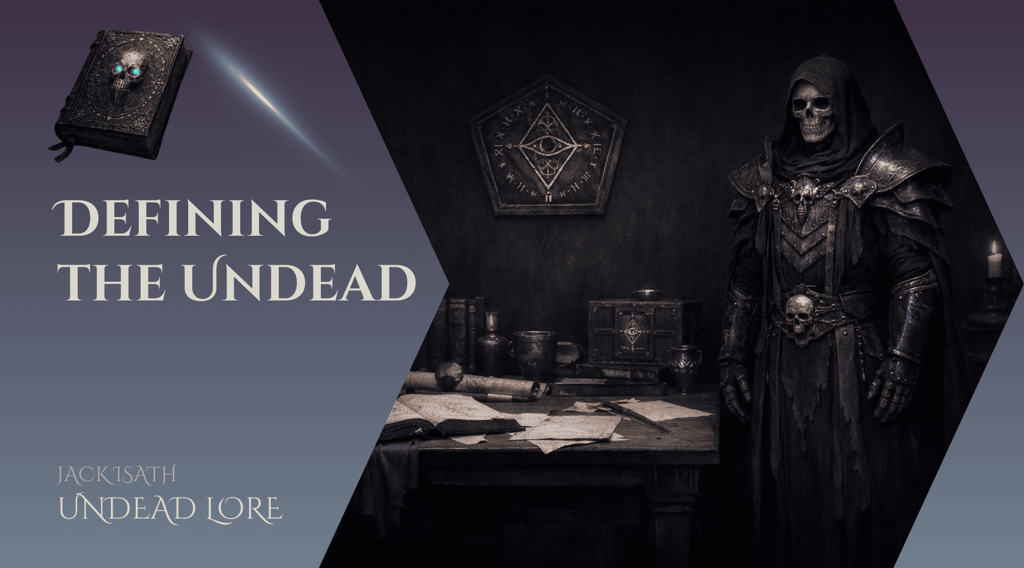
Undead beings are deceased creatures that continue to move or exert agency beyond death. They often require no food or breath and persist through supernatural, magical or scientific means. Undead manifestations fall into two broad classes:
Corporeal Undead
Rotting, preserved, or animated bodies such as zombies, skeletons, mummies and vampires. They can interact physically with the living and may be destroyed by damaging their bodies or disrupting the magic animating them.
Incorporeal Undead
Disembodied spirits like ghosts, specters and banshees. They lack solid form, pass through walls and are usually tied to unfinished business.
Undead can be mindless husks, like shambling zombies or obedient skeleton soldiers, or sentient creatures with human-like intelligence, such as vampires and liches.
Some retain the personality of the deceased, while others are animated by external spirits or demons. Their traits often signal unnaturalness: cold skin, lack of heartbeat, pallor and powers to drain life or induce terror.
How the Term Evolved
The word “undead” originally meant “not dead” and was used in older texts simply to mean alive. Bram Stoker popularized the modern sense when he considered titling his 1897 novel Dracula The Un-Dead and used the term for vampires.
By the early 20th century the term became a convenient umbrella for reanimated or restless dead, applied to mummies, zombies and other revenants. Earlier folklore had distinct names like revenant for a returning corpse, vampire for a blood‑sucker and ghoul for a flesh‑eating demon but “undead” now encompasses all types of undead creatures and beings.
Roots in Myth and Folklore
Stories of the restless dead appear worldwide. Key examples include:
Ancient Mesopotamia
The Epic of Gilgamesh describes the goddess Ishtar threatening to “bring up the dead to eat the living,” one of the earliest references to a dead uprising.
Europe
Medieval chronicles tell of revenants rising to attack villages; Norse sagas portray draugr corporeal corpses with superhuman strength that must be beheaded and burned to rest.
China
The jiangshi or “hopping corpse” is a stiff reanimated body that hops and drains life force, often held in check by Taoist talismans.
India
The vetala is a spirit that inhabits corpses and tells riddles; it inspired 19th‑century Western translations like Vikram and the Vampire.
Arabia and Japan
Ghūls are desert demons that devour flesh, while Japanese lore has yūrei (ghosts) and onryō (vengeful spirits).
African diaspora
Haitian Vodou describes a zonbi as a living person robbed of their will; a sorcerer can capture part of the soul and force the victim to serve as a mindless laborer. This idea of enslavement after death influenced later zombie fiction.
These traditions show that cultures developed diverse undead concepts to express fears of improper burial, moral transgression and unresolved deaths. Archaeologists have found “deviant” burials, skeletons pinned with stakes or weighed down, to prevent the dead from rising.
Religious and Occult Perspectives
Major religions generally treat the undead as unnatural.
In Judaism, Christianity and Islam, the dead await resurrection and should rest peacefully; a walking corpse is typically seen as demonic or heretical. Medieval Christians explained revenants as either satanic animation or punishment for an unholy life.
Necromancy, summoning or raising the dead, was widely condemned, with exorcisms used to quell spirits.
Eastern traditions are more varied. Hindu and Buddhist cosmologies include ghosts (preta, bhut) as spirits of those who died unnaturally; rites and offerings appease them. Taoist folklore allows that an improper balance of yin and yang can lead to reanimated corpses; priests perform rituals to anchor souls. Haitian Vodou’s zombies are victims of sorcery which is seen as a violation of divine order rather than as monsters.
Literary Development
Gothic fiction set the stage for undead tropes. Mary Shelley’s Frankenstein (1818) used science to resurrect a patchwork corpse, introducing sympathy for an artificially created being. John Polidori’s The Vampyre (1819) and later works like Varney the Vampire and Carmilla refined the sophisticated vampire archetype. Edgar Allan Poe wrote about premature burial and mesmerized corpses.
Bram Stoker’s Dracula (1897) synthesized vampire lore into a cursed aristocrat whose victims risk becoming undead, cementing vampires as icons. Literary mummies emerged through Egyptology, and early science‑fiction stories imagined mass reanimation. By the early 20th century, four distinct archetypes were firmly established: vampires, ghosts, reanimated corpses and mummies.
Undead in Modern Horror
The 20th century transformed undead on screen. Universal’s Dracula (1931) and The Mummy (1932) turned literary creatures into cinematic stars. White Zombie (1932) introduced audiences to voodoo‑style zombies as mindless enslaved workers.
George A. Romero’s Night of the Living Dead (1968) revolutionized zombies: corpses reanimated by unknown causes that crave human flesh. The film also introduced the apocalyptic outbreak narrative and social commentary that zombies are metaphors for consumerism and civil unrest. Later zombie films codified rules: zombies move slowly, transmit undeath by biting and can be stopped only by destroying the brain.
Vampires, meanwhile, oscillated between horror and romance. Anne Rice’s Interview with the Vampire humanized them. By the 2000s, series like Twilight portrayed vampires as love interests, while other works returned to feral blood‑drinkers, showing the genre’s flexibility. Ghost stories remained popular, often focusing on psychological horror.
Fantasy and Science‑Fiction Variations
In fantasy settings, undead appear as monsters and sometimes allies. Tabletop games like Dungeons & Dragons classify skeletons, zombies, ghouls, wights, vampires and liches, introducing mechanics such as “Turn Undead”. High‑fantasy worlds feature necromancers, undead armies and even “undead societies” ruled by vampire counts.
Science fiction often rationalizes undead with viruses, radiation or nanotechnology, raising questions about what constitutes life. In urban fantasy and comics, vampires, zombie comedies and ghost detectives mix horror with action or romance. These cross‑genre experiments show the undead can be terrifying, tragic, amusing or thought‑provoking.
Undead in Games
Undead are ubiquitous in games. Dungeons & Dragons codified undead types and weaknesses. Video games use them because they are easy to recognize, ethically simple targets and mechanically versatile.
Players fight hordes of zombies as low‑level fodder or face powerful liches; some games let players control or create undead minions. Interactive stories like The Walking Dead series use undead scenarios to explore moral choices. Even non‑horror games feature undead during Halloween events.
Classifying the Undead
A basic taxonomy helps clarify the variety of undead:
Corporeal vs. Incorporeal
Bodies such as zombies and vampires versus spirits like ghosts or wraiths.
Mindless vs. Sentient
Instinct‑driven zombies versus intelligent vampires and liches.
Origins
Magical (curses, necromancy), biological (viruses, radiation), demonic possession or other supernatural causes.
Not Truly Undead
Immortal beings like gods or elves never died and are distinct from resurrected corpses.
Understanding these categories clarifies narratives: sunlight and stakes kill vampires; decapitation or burning stops revenants; ghosts require exorcism; zombies fall when their brain is destroyed.
Cultural Impact and Reception
Undead figures mirror societal anxieties. Gothic literature reflected 19th‑century obsessions with mortality and repressed desires. The Great Depression era embraced supernatural escapism through monster films. Romero’s zombies resonated during times of social upheaval and continue to symbolize fears of disease, consumerism and societal collapse.
Vampire depictions shift with cultural attitudes toward sexuality and otherness, sometimes monstrous, sometimes romantic. Ghost stories persist everywhere, adapting to new technologies and urban legends. Awareness of cultural origins is crucial; for example, Haitian zombie beliefs reflect colonial history and should not be reduced to Hollywood caricature.
Conclusion
The concept of the undead spans definitions, cultures, religions and media. It encompasses mindless corpses, sentient spirits, cursed immortals and scientific abominations.
Their enduring appeal lies in their flexibility: they embody our fears of death and the unknown, but also allow storytellers to explore morality, identity and societal critique.
Recognizing the diverse origins and meanings of undead creatures enriches our understanding of horror, fantasy and the human imagination.